
Reviewed by Dr. Kira Leedom, DVM, MPA, founder and veterinarian.
Your dog used to set the pace on the trail. Now you notice it the next morning instead: the slow push up off the dog bed, the back legs that take a few steps to loosen, the pause at the bottom of the stairs while they work out whether it’s worth it.
So you do the kind thing and start trimming: shorter walks, no cold mornings, and letting them sleep in because they’ve earned it.
But low-impact exercise for senior dogs is really a question of how much force goes through the joint each time a paw lands, and how long you’re out barely comes into it. Separate those two and the week gets much easier to plan.
Rest used to be the standard advice. Dogs with sore joints were put on “exercise restriction” for years, until it became clear that strict rest puts weight on, stiffens the joints further and takes muscle off the back end, which is the same decline everyone was trying to avoid.
This guide covers when your dog counts as a senior, how much daily movement to aim for, which exercises to keep and which to drop, and what a Front Range winter changes about all of it.
Is My Dog Actually a Senior Yet?
Dogs reach “senior” at very different ages depending on size, which is why a Great Dane and a terrier can be the same age and nowhere near the same stage. Getting it roughly right is what lets you adjust early instead of waiting for a limp.
What age is a senior dog, by breed size?
Size matters more than anything else:
- Giant breeds, like Great Danes: 6 to 7 years
- Large breeds, including Labs, Goldens, GSPs and Vizslas: 7 to 8 years
- Medium breeds, including Aussies and Border Collies: 8 to 10 years
- Small breeds: 11 to 12 years
That catches a lot of Boulder County owners off guard, because the dogs that do well on Front Range trails are mostly the big ones. Your hiking partner can tick over into “senior” at seven and still haul you up the first mile like nothing has changed.
Don’t treat it as a deadline. Plenty of nine-year-olds are in better shape than some six-year-olds, and all the number really does is tell you when to start watching more closely.
What are the early signs of arthritis in dogs?
The early signs are easy to miss because they look like ordinary aging. The most useful one is stiffness that shows up after rest rather than after exercise: a dog who is creaky for the first few minutes of a walk and then loosens up by the end of the block is telling you something.
Watch for:
- Difficulty standing up or lying down
- Stiffness after resting, especially first thing in the morning
- Limping, or favoring one leg
- Reluctance to start a walk they used to love
- Heavy panting or labored breathing on an easy outing
- Slowing down noticeably partway through
Any of these is worth a vet visit rather than a guess. Stiffness has several possible causes, and what helps depends on which one you’re dealing with. Senior dogs should be seen every six months anyway, and a sudden change in how your dog moves is worth an appointment that week.
Does Low-Impact Exercise for Senior Dogs Mean Doing Less?
No, and this is the part of senior dog exercise worth getting right first.
What the research actually says about rest
The old prescription for an arthritic dog was rest, and it has been dropped. A dog kept on the couch for weeks puts on weight, loses the muscle around its hips and knees, and comes back stiffer than it went in.
What replaced it is exercise modification: keep the dog moving, every day if you can, rather than resting all week and making up for it with a long hike on Saturday.
People with knee and hip arthritis get the same advice. Walking, water exercise and strength training all reduce their pain, and the American College of Rheumatology counts aerobic exercise and joint mobility among the core parts of managing the condition.
The evidence in dogs is thinner. The best-known study, published by Greene and colleagues in JAVMA in 2013, looked at 60 Labrador Retrievers with hip dysplasia. The dogs getting more than an hour of exercise a day had lower lameness scores than those getting under 20 minutes, and in the same group, anti-inflammatory and joint-supplement use wasn’t linked to better scores.
Two caveats matter:
- The study could not establish which way the arrow runs. More exercise may ease lameness, or less lameness may simply allow more exercise.
- It covered one breed and one joint, so it is not a prescription of 60 minutes for every dog.
So the study can’t tell you how far to walk your own dog. What it does show is that the dogs who moved more were the ones scoring better, and the dogs on medication weren’t.
Why “low impact” is about force rather than duration
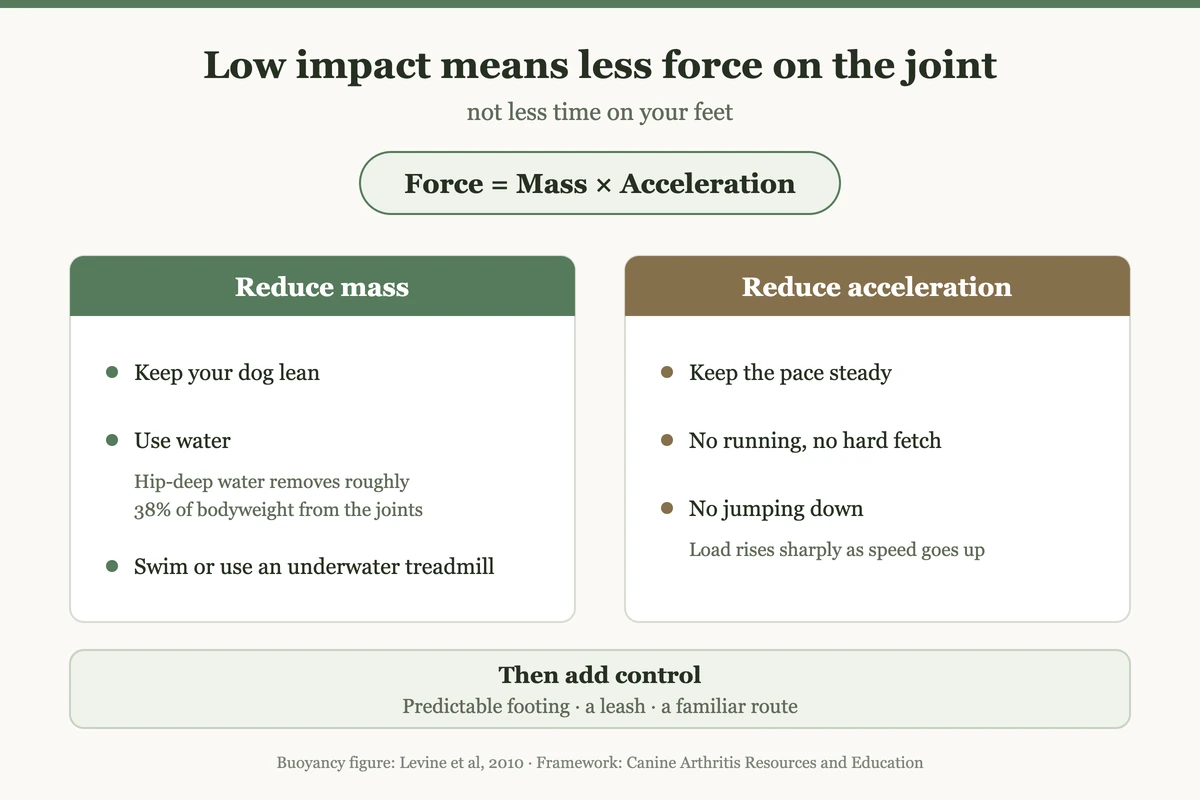
Low impact is about reducing the force on the joint rather than cutting the time you spend walking. Force is mass times acceleration, so there are two things you can change.
Reduce mass
Keeping your dog lean is the most direct way. Water is the other, since buoyancy carries part of the load: in an underwater treadmill filled to hip height, about 38% of a dog’s weight comes off the joints.
Reduce acceleration
This is about how fast the force arrives. A dog jumping down out of the back of a car lands far harder than one walking the same distance, and the faster and more sudden the movement, the worse it gets for the joint. Running, jumping and hard stops are the ones to cut.
Then there’s control: steady footing, a leash, and a route your dog already knows. Regular, low-impact and controlled is the whole prescription, and nothing in it says the walks have to get shorter.
How Many Times a Day Should a Senior Dog Be Walked?
Two or three short walks a day work better than one long one. For most senior dogs that adds up to 30 to 60 minutes of movement daily, in sessions of roughly 10 to 20 minutes.
The daily target, and how to split it
Work out the daily total first, then divide it up. Around a normal working day, that might look like this:
| When | How long |
|---|---|
| Morning | 10 to 15 minutes |
| Midday | Around 10 minutes |
| Evening | 20 to 30 minutes |
If your dog is stiffer or further along, keep the days and shrink the sessions. Five to fifteen minutes at a time is plenty, and 20 to 30 minutes across the whole day is a reasonable target when an hour is out of reach.
What matters most is that it happens most days. A short loop around the block every morning does more for a stiff dog than a big outing once a week.
Let your dog set the pace. Build in stops, let them sniff, and don’t hold them to the speed you’d walk on your own. If they start lagging behind, sitting down repeatedly or breathing hard, the walk is done for the day and it’s time to head home. Panting that doesn’t settle once you’re back indoors is a different problem with its own causes.
What about the days that don’t work?
Some days the plan won’t survive: a flare-up, a storm rolling in off the foothills, or a dog who plainly isn’t up for it.
A lighter day or a day off doesn’t undo anything. What counts is that your dog gets out on most days, most weeks.
When it’s the weather, bring the session inside instead of skipping it. Slow laps of the hallway, a scent game or a few gentle steps all keep the joints moving without a sidewalk, and we’ve written separately about indoor dog activities for a Colorado winter if you want more ideas.
Which Low-Impact Exercises Are Worth It, and Which Should You Skip?
Most lists of senior-dog exercises cover the same ground, so below is what each one does for the joint and where it stops being a good idea. All of it applies just as well as exercise for dogs with joint pain at any age, whether that’s a twelve-year-old Lab or a five-year-old coming back from a knee injury.
Exercises worth keeping
Leashed walking on soft ground
Grass and dirt are easier on old joints than asphalt or gravel, but soft ground also makes every step more work, so twenty minutes on sand or long grass will tire your dog out faster than twenty minutes on a flat sidewalk.
Swimming and underwater treadmill work
Water takes care of the mass half of the job. Plenty of rehabilitation centers run canine hydrotherapy sessions, and a controlled session in a pool is a very different thing from throwing a ball into a cold lake.
Controlled steps
A few slow trips up and down the stairs keep the joints working. Only do it where there’s real grip underfoot, never on bare hardwood, and never with a dog who has severe joint disease, so check with your vet first.
Balance and strength holds
These get skipped more than anything else here, and they probably give the most back for the time they take. Lift one leg and hold it for 5 to 10 seconds, two or three holds per leg, every day or two, working up to 20 seconds as your dog gets steadier. Dogs carry 60 to 70% of their weight on their front legs, so the back end is usually where strength has slipped without anyone noticing.
Scent work
The joints barely move and the dog still comes home tired. It’s also something you can keep doing a long way into old age: Cornell’s Riney Canine Health Center notes that 16- and 17-year-old dogs are still competing in scent sports.
What to avoid, including dog parks
The clear ones to drop are running, jumping down, hard games of fetch and rough play with other dogs.
The dog park is a harder call, because it’s uncontrolled exercise almost by definition. Dogs there sprint, jump, twist and change direction without warning, and on joints that are already compromised, that combination often ends in lameness. Medically, the advice is to skip it.
But some dogs live for it, and if yours starts whining with excitement two blocks out, taking that away has a real cost, and their quality of life belongs in the decision alongside their joints. For a dog like that, shorter visits at quiet times and a close look at how they move the next morning are a reasonable compromise. When it stops being worth it, there are quieter alternatives to dog parks around Boulder County.
What Makes a Boulder County Winter Harder on a Senior Dog?
A Front Range winter turns a few of the summer rules around.
Cold, ice and footing
Older dogs feel temperature extremes more than young ones, and cold, damp air can make arthritic joints noticeably worse. That turns the timing around: in July you’re out at six to beat the heat, and in January the middle of the day is usually the better window.
Footing changes too, and a dog who already struggles to get up off the kitchen floor has very little to spare on an icy sidewalk, so on a winter walk you’re managing grip more than distance. Booties help with that as much as they help with protecting paws from winter de-icer.
Familiar routes matter more in winter, too. A dog who’s losing sight or hearing walks a path they know with far more confidence than a new one, and that shows in how readily they keep going.
Which local routes actually work for a stiff dog?
Our guidance for older and mobility-limited dogs is short, quiet, flat, low-traffic outings, timed to miss the crowds, where how good the outing is counts for more than how long it lasts. A few places around Boulder County fit that well.
Waneka Lake Trail, Lafayette
The loop is about 1.2 miles, mostly crushed gravel 8 to 10 feet wide that holds up in most weather, with a bathroom and a drinking fountain on the way round. That width matters once your dog can’t step aside quickly for a bike or another dog.
Warembourg Fish Pond Loop, Louisville
Flat and easy on the paws, and it suits dogs across a wide range of ages and fitness levels.
Coal Creek Trail
A gentle trail for a slow stroll, and an easy one to turn around on whenever your dog decides they’ve had enough.
Kneebone Open Space, Lafayette
Paved paths through open grass meadows, so the surface underfoot is predictable.
Whichever you pick, choose somewhere you can cut the walk short without it becoming a problem.
Conclusion
Letting an old dog rest feels like the kind thing to do, but over a winter it costs them muscle, mobility and comfort.
What helps instead is something every day, in short pieces, on ground that doesn’t jar the joints, adding up to thirty to sixty minutes with your dog setting the pace. A loop of the block before work counts, and so do ten minutes of sniffing around the yard at lunch.
How hard any walk is on an old dog comes down to pace and terrain, and you control both.
For most working households the hard part is midday. That’s the gap a professional walker fills: the same walker every visit, someone who knows how your dog moves well enough to notice the week it starts to change.
If you’d like help building that routine around your own dog, start with the Off Road Paws dog fitness questionnaire.
Frequently Asked Questions
Should you walk a 14-year-old dog?
Yes, in almost all cases. A 14-year-old usually needs shorter, slower walks on softer ground, with more stops to sniff and rest, but age on its own isn’t a reason to stop. Check with your vet first if there’s a known joint or heart condition.
How far should you walk a 12-year-old dog?
There’s no set distance. Plan by time instead: start with 10 to 15 minutes, then watch how your dog gets up the next morning. Shorten it if they’re stiff, and add a few minutes if they’re fine. Turn back early if they lag or pant heavily.
How do I get my old dog to exercise?
Start small and make it interesting. A five-minute walk with plenty of time to sniff, a few treats hidden around the living room, or a slow loop somewhere new to smell will often get an old dog moving when a longer walk won’t.