Reviewed by Dr. Kira Leedom, DVM, MPA, founder and veterinarian.
If a puppy came home to your house this month, someone has probably already told you about the 5-minute rule: five minutes of exercise for every month of age, twice a day. Then your 12-week-old spends twenty minutes tearing laps around the backyard, and you’re left wondering whether the walk you planned for later is now off the table.
Most of the time it isn’t. The rule was written as a cap on formal exercise, meaning the leash walks and training sessions where you set the pace. The running, digging and wrestling your puppy does on its own terms is a different thing, and most versions of the rule skip over it.
What protects a growing puppy’s joints has less to do with minutes than with how it moves and what’s under its feet. That means grass and dirt over pavement. It also means play your puppy can walk away from whenever it likes, and as few stairs and jumps as you can manage for the first few months.
The chart of puppy exercise by age is further down. So are the soft, flat trails around Boulder, Louisville, Lafayette and Broomfield that suit a puppy still growing into its legs.
How Much Exercise Does a Puppy Need?
Where does the 5-minute rule come from?
The rule comes from The Royal Kennel Club in the UK: five minutes of formal exercise per month of age, up to twice a day, until your puppy is fully grown. A three-month-old gets two walks of up to 15 minutes. At four months it’s up to 20, and so on.
The Kennel Club is fairly modest about it. It calls the rule “a good rule of thumb,” says breeds and individual dogs vary, and tells owners they’ll know their own dog best. It was never meant as a clinical threshold, so treat it as a ceiling for your walks rather than a daily quota to hit.
Formal exercise vs. free play
Formal exercise is anything where you set the pace and your puppy has to keep up: a leash walk around the neighborhood, a training session, a lap of the park on your schedule. In free play your puppy decides when to run, when to sniff and when to flop down in the grass.
The 5-minute rule only caps the first kind. On the same page, the Kennel Club calls informal play one of the most important forms of exercise a puppy gets. Play builds muscle, strengthens joints and teaches a puppy how to behave around other dogs. Left to themselves, most puppies also stop when they’re tired and sleep a lot.
That only works if your puppy is allowed to stop, though. Very young puppies are bad at knowing when they’ve had enough, especially with an older dog or a child egging them on. So keep leash walks within the five-minute guideline and let play happen at your puppy’s pace on soft ground. When the zoomies turn frantic, call a nap yourself instead of waiting for your puppy to.
Why Does the Kind of Exercise Matter More Than the Minutes?
What are growth plates, and when do they close?
Growth plates are soft areas of developing cartilage near the ends of a puppy’s long bones, where the bone grows in length. Until they close, they’re easier to damage than finished bone. Much of the usual puppy advice is really about protecting them.
The American Kennel Club says they can close as early as 8 months in small breeds. Large and giant breeds may not be fully mature until somewhere between 18 and 24 months, and the AKC warns that jumping on open growth plates can cause long-term damage.
That’s a long wait for the dogs most Boulder County households bring home. A Lab, a Bernese or a doodle from a large-breed line can look grown on the trail at a year old while its skeleton is still a puppy’s.
What the research found about stairs and soft ground
The best study on this comes from Norway. Researchers followed 501 puppies from 103 litters of four large breeds (Newfoundlands, Labrador Retrievers, Leonbergers and Irish Wolfhounds) from birth to their hip screening at 12 or 18 months, recording how each one was housed and exercised along the way (Krontveit et al., *American Journal of Veterinary Research*, 2012).
Puppies that walked on stairs between birth and three months old were more likely to develop hip dysplasia, while puppies that got off-leash exercise over the same period were less likely to. The authors recommended keeping puppies of three months and under off stairs, and giving them outdoor exercise on soft ground in moderately rough terrain.
It’s one study of four large breeds, and it only measured hip dysplasia, so nobody can say the same holds for a Beagle or a Border Collie. For a Lab or Bernese puppy, it’s the best evidence there is.
What should you limit while your puppy grows?
Most puppy don’ts come down to three things. Once you know them, you can judge a new activity for yourself.
- Impact from jumping off the couch or out of the car, being taught to jump, landing hard on pavement, or the sharp turns of a ball chase. The Royal Kennel Club lists high-impact exercise and sharp turns among the things that raise a puppy’s risk of permanent joint problems.
- Repetition, meaning the same movement over and over without a break: jogging beside you, a long walk on concrete, thirty throws of the same ball. Free play rarely looks like that. A puppy left to itself runs, stops, sniffs and changes direction whenever it likes.
- Extra weight puts more load on the same joints, and overweight puppies are more likely to develop joint disease as they mature. Keeping yours lean is part of protecting them.
Puppy Exercise by Age: A Stage-by-Stage Guide
The walk limits in this table come from the Royal Kennel Club’s rule. Everything else comes from a much more detailed age chart by Freedom Service Dogs of America, a service-dog organization. Read the walk column as a ceiling. If your four-month-old is happily done after ten minutes, stop there.
| Age | Leash walk (upper limit) | Slow “sniff and stroll” | Good activities | Not yet |
|---|---|---|---|---|
| 8–12 weeks | Up to 10–15 minutes, twice a day; distance as short as 50–200 feet at a time | Up to 15 minutes | Free play on grass, balls rolled along the ground, gentle tug with the toy held low, 2 minutes of leash practice | Stairs, jumping off furniture, play dates longer than 10–15 minutes |
| 3–4 months | Up to 15–20 minutes, twice a day | Up to 20 minutes | Short walks on new surfaces, low wobble boards, play with calm adult dogs | More than two or three stairs on their own, directed running |
| 4–6 months | Up to 20–30 minutes, twice a day | Up to 45 minutes by 6 months, at a slow pace | Leash training sessions of 5–10 minutes, play dates of 20–30 minutes | Unsupervised stairs, jogging, long fetch |
| 6–12 months | Up to 30–60 minutes, twice a day; keep pavement short | Up to 60 minutes by 12 months | Steady walks of 20–30 minutes on level, soft ground; hiking introduced gradually; low jumps up to half elbow height; gently tossed toys | Repeated stairs at a run, rough body-slamming play, directed running |
| 12–24 months | Gradually toward adult levels once your vet confirms growth has finished | As much as your dog enjoys | Longer trail days, built up over weeks | Running and jumping sports until growth plates close (later for large breeds) |
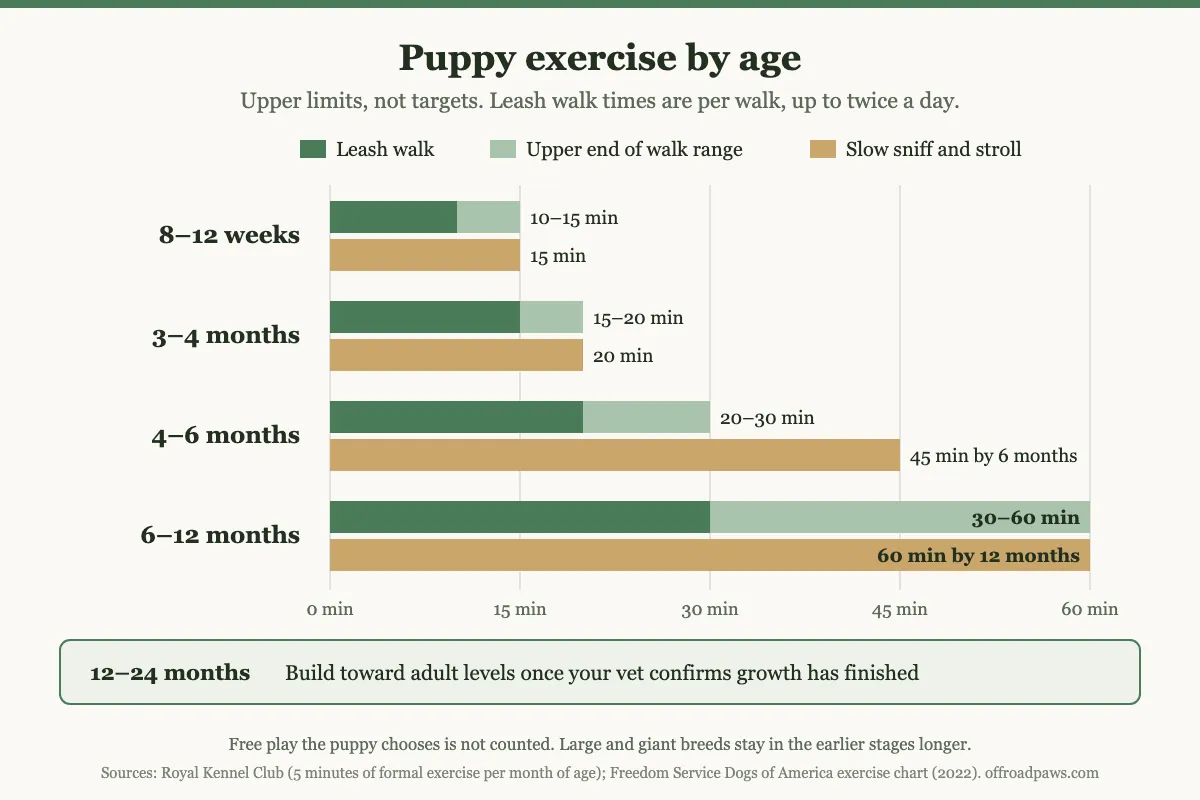
The sniff-and-stroll column goes well past the five-minute figure from four months on. A slow walk where your puppy stops every few feet to investigate is a different kind of outing from keeping pace at your side, and all that sniffing is tiring in its own right.
What changes for large and giant breeds?
Labs, Golden Retrievers, Bernese Mountain Dogs, doodles and big mountain mixes fill Boulder County trailheads. They’re also the breeds whose growth plates stay open longest, often until 18 to 24 months.
Keep these dogs in the 6–12 month row well past their first birthday. Check with your vet before you start running together or try agility-height jumps. The AKC suggests waiting until at least 12 to 15 months for high or competitive jumping, and longer for giant and slow-maturing breeds.
How can you tell your puppy has had enough?
On a walk you’re leading, a puppy tends to keep up with you rather than stop, so it’s on you to watch. Head home if you see any of these:
- Lying down or sitting mid-walk, or lagging behind you
- Heavy panting that doesn’t settle quickly
- A limp of any kind, even one that fades
- Stiffness or reluctance to get up the next morning
- Overtired behavior that looks like extra energy, such as biting, zooming or ignoring cues your puppy usually knows
A limp or stiffness the next day is worth a call to your vet, especially if it comes back.
When Can Your Puppy Start on Boulder County Trails?
Vaccinations first, but don’t keep your puppy home
The first three months of a puppy’s life are the most important time for getting used to new people, places and dogs, and most of that time passes before the vaccine series is finished. The American Veterinary Society of Animal Behavior’s position is that socialization should start before vaccinations are complete, as long as your puppy has had its first set, is healthy and stays current with the rest (AVSAB position statement, via the AVMA).
So get out, just not where lots of unknown dogs pass through. Carry your puppy along a quiet street, visit a friend’s yard where the resident dog is vaccinated, or sit outside a coffee shop together. Leave dog parks and busy trailheads until your vet says the series is done.
Why it’s leash time, not Voice & Sight, for now
On City of Boulder open space, a dog can only be off leash if its guardian has registered in the Voice & Sight program, completed the city’s course and displays the tag. The dog also has to come back immediately when called, whatever the distraction (City of Boulder).
Very few puppies can do that yet. A leash also stops your puppy from chasing a bigger dog or a bike until its legs give out. Keep trail walks on leash and save off-leash running for a fenced yard, where your puppy can stop whenever it wants.
Soft, flat routes for a growing puppy
The Norwegian researchers recommended soft ground, and there’s plenty of it close to home:
- Coal Creek Trail (Louisville and Lafayette): Boulder County describes it as a soft-surface trail, mostly packed aggregate with a few short concrete stretches. Dogs must be leashed. A short out-and-back from Louisville Community Park keeps the distance easy to control.
- Bobolink Trail (south Boulder): a flat dirt trail along South Boulder Creek, with leashed dogs welcome. Stick to the dirt rather than the paved South Boulder Creek path that runs nearby.
Save Mount Sanitas, Chautauqua’s steeper trails and anything with long rocky descents until your puppy’s growth plates have closed. Coming down those trails means jarring step after jarring step and hopping down ledges, so your puppy gets impact and repetition at once.
What changes in a Front Range winter?
Fresh snow is soft underfoot, but wading through it takes far more effort than walking on a path, so keep snowy outings shorter than the table suggests. Ice is the bigger worry. A slip or a sudden stop is exactly the kind of impact you’re trying to avoid, so skip icy sidewalks and stick to dry or well-packed routes.
Ice-melt salt on sidewalks can dry and crack paw pads. Wipe your puppy’s feet when you get home, or try paw wax or booties if your puppy will put up with them. Small and short-coated puppies also lose heat quickly.
A simple test: if you wouldn’t be comfortable outside without a coat, it’s probably too cold for a small or thin-coated puppy to exercise for long. On the coldest days, short indoor play and sniffing games can stand in for the walk.
Conclusion
Use the five-minute rule for the walks you lead and not much else. Keep those walks short, let your puppy play at its own pace on grass and dirt, and go easy on stairs, jumps, hard pavement and long repetitive sessions until its growth plates close.
Most of what turns a puppy into a trail dog happens in this first year, and very little of it looks like exercise: sniffing along Coal Creek, wrestling on the lawn, napping when you call time. If you have a large-breed puppy, Sanitas will still be there once those growth plates have closed.
When your dog is fully grown and your vet has given the all-clear, that trail life is what Off Road Paws is built around, with the same walker every visit and routes chosen for your dog’s age and fitness.
Frequently Asked Questions
Can I take my puppy on a 30-minute walk?
It depends on age and pace. Under the Royal Kennel Club’s guideline, a 30-minute leash walk fits a puppy of about six months. Younger puppies do better on slower outings, and Freedom Service Dogs’ chart allows a 20-minute sniff-and-stroll at 12 to 16 weeks.
What age can a puppy go hiking?
Short hikes on dirt or grass can start at six to twelve months, once it’s vaccinated and walks well on a leash. Save long or steep trails until growth plates close, which the AKC puts at about 8 months in small breeds and 18 to 24 in large ones.
When can I start running with my puppy?
Affton Veterinary Clinic recommends waiting until a puppy is at least 9 to 12 months old before you run together, and longer for large and giant breeds. Until then, stick to the running your puppy chooses in play, and let your vet tell you when growth has finished.