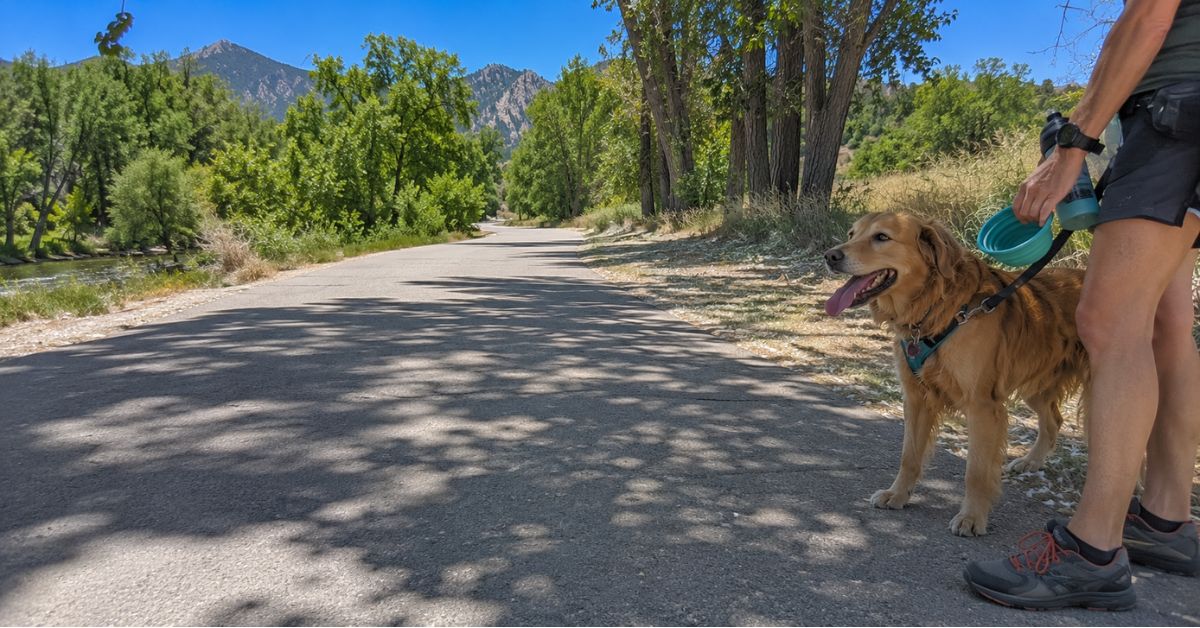
How Hot Is Too Hot to Walk a Dog in Colorado?
An 85°F day in Boulder is not the same as an 85°F day in Atlanta. The number on your phone looks identical. The way your dog experiences it is not.
Most owners think the biggest heat danger is a parked car. The largest veterinary study ever conducted, 905,543 dogs tracked across UK primary care (Hall et al. 2020), found something different. Roughly 74% of canine heatstroke is exertional, triggered by exercise rather than hot cars or static heat. Of those exertional cases, two out of three happened after a walk. Not a run. A walk.
That single finding rewires the safety question. The real risk isn’t leaving your dog in the car. It’s the routine afternoon loop you’ve been doing all summer. And here on the Front Range, the math gets harder still: altitude, UV intensity, pavement physics, and dry-air dehydration all stack against your dog in ways generic national advice doesn’t account for.
This guide fixes that. Written by the veterinary-led team at Off Road Paws, serving Boulder, Louisville, Lafayette, Broomfield, and Superior since 2015, you’ll get a Colorado-specific framework built on peer-reviewed research, real surface-temperature data, named Boulder-area trail recommendations, and a decision matrix you can actually use the next time the forecast climbs.
What the Research Actually Says About “Too Hot” (and Why Most Articles Get It Wrong)
The exertional heatstroke finding that reframes everything
When Hall and colleagues analyzed 905,543 UK dogs in 2020, they sorted every heat-related illness by what caused it. Exertional cases (heatstroke triggered by exercise) made up 74.2%. Environmental heat (lying in a hot room or yard) accounted for just 12.9%. Hot cars? Only 5.2%.
The deeper detail matters more. Of the exertional cases, 67.5% happened after walking, not high-intensity play or running. And exertional heatstroke kills at roughly the same rate as environmental: a 14% case fatality either way.
The everyday walk isn’t a milder version of leaving your dog in a car. It’s the more common version of the same emergency.
The clinical thresholds, defined
A healthy dog’s normal body temperature sits between 100°F and 102.5°F. Heat-related illness begins above 104°F. The 2026 revised VetCompass clinical grading tool, the most current framework veterinarians use, flags 41.0°C (105.8°F) as a critical-temperature criterion for moderate-to-severe heatstroke.
One more number worth knowing at home: when actively cooling a hyperthermic dog, the AKC Canine Health Foundation advises stopping at 103°F to avoid overshooting into hypothermia. We’ll come back to that in the cooling protocol below.
These aren’t arbitrary cutoffs. They mark where a dog’s thermoregulation has measurably failed.
Is there a single “too hot” temperature for all dogs?
Texas A&M’s veterinary school and recent veterinary reporting agree on a point most blog posts dodge: there is no universal “too hot” number. Breed, age, coat thickness, underlying health, and the surface under the dog’s paws all interact.
Bulldogs have been documented developing dangerous hyperthermia at just ~70°F of room temperature (Lilja-Maula et al., cited in Hall 2020). A young Labrador might be fine at 85°F in shade with water. The right question isn’t what’s the magic number? It’s what does today’s combined risk profile look like for my dog?
That profile is exactly where Colorado changes the math.
Why Colorado Is Different: The Altitude Effect Generic Blogs Miss
UV intensity at Boulder’s elevation
The atmosphere thins as you climb. Less air column overhead means less UV filtration before sunlight reaches the ground. The EPA estimates UV intensity rises about 6% per kilometer of elevation, and USDA UV-monitoring measurements (Lantz et al. 2006) recorded an even steeper climb of roughly 15% in the first kilometer above sea level.
At Boulder’s 5,400 feet, that translates into something measurable: peak summer UV Index readings regularly reach 9 to 11, in the “very high” to “extreme” range. Coastal cities at the same latitude usually top out around 8.
Higher solar irradiance doesn’t just affect sunburn risk for you and your dog. It heats every surface faster, which is why an 85°F day in Boulder produces hotter pavement than an 85°F day in a lower-elevation city.
Dry air, fast dehydration
Boulder sits in a cold semi-arid climate zone. Summer afternoons feel comfortable to humans precisely because the humidity is low, but that same dryness works against your dog.
Dogs don’t sweat except through their paw pads. Panting is their primary cooling mechanism, and every pant exhales moisture. In dry air, that water loss accelerates. Combined with altitude, the dehydration curve climbs faster than most owners expect. Your dog can be in fluid trouble well before you’d notice the same effect on yourself. It’s the single most common mistake we see across our Boulder, Louisville, Lafayette, Broomfield, and Superior service area.
How often does Boulder get hot enough to be dangerous for dogs?
The NOAA Boulder station’s 1991 to 2020 normal is 32.7 days per year at or above 90°F. The recent five-year average (2021 to 2025) has jumped to 43.6 days, about 33% above the long-term norm. July alone averages 14.2 such days, roughly half the month.
The hottest hours in Boulder are 3 to 5 PM, not noon as most people assume. That single fact reshuffles the safe-walking window in ways the next section will make tangible: at those temperatures, the air is only half the problem.
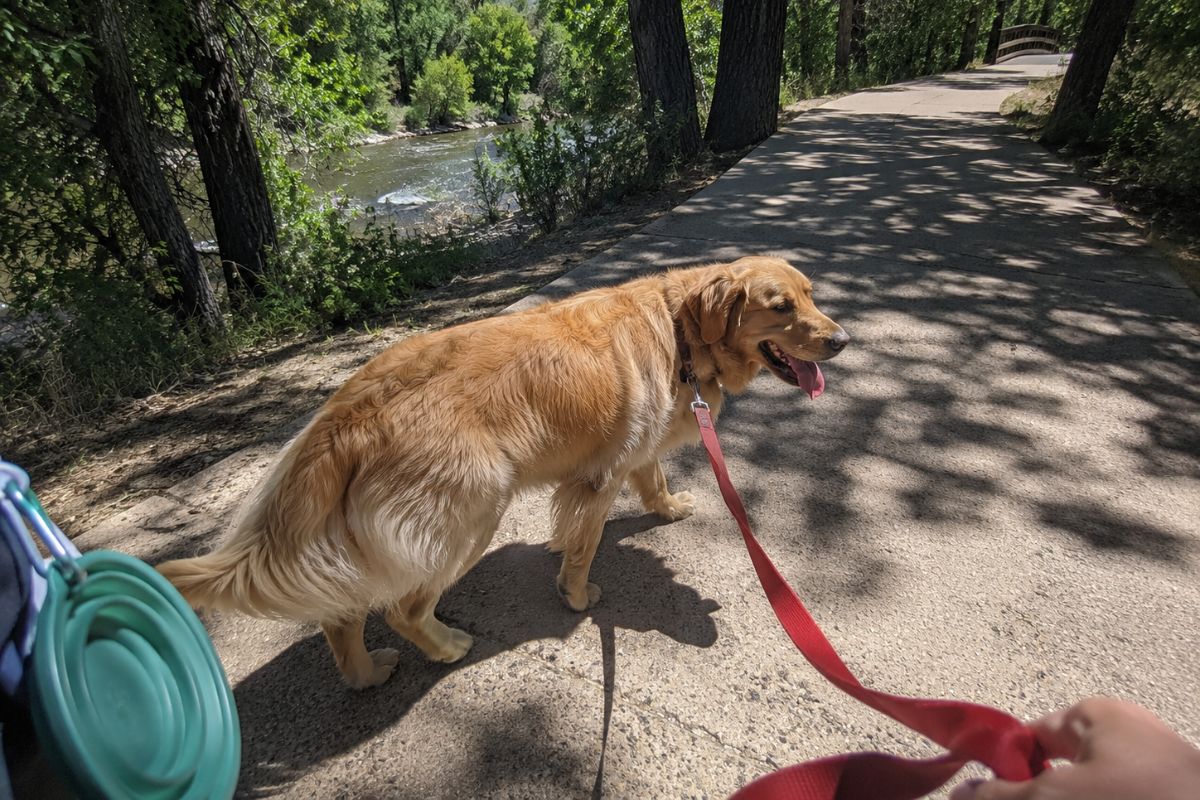
How Hot Is the Pavement, Really? The Surface-Temperature Truth
The peer-reviewed numbers
You’ve probably seen the figure quoted everywhere: 77°F air temperature produces 125°F asphalt. That number traces back to Berens 1970 in JAMA, and the original paper notes the field measurement was “unverified.” It’s a useful ballpark, not a controlled study.
The modern peer-reviewed source is Chestovich et al. 2023 in the Journal of Burn Care & Research: 75,000 surface-temperature measurements across six materials. Asphalt reached 166°F when ambient air was 120°F. More usefully for Colorado, the study found sunlit surfaces ran 36 to 56°F hotter than shaded surfaces of the same material.
Surface ranking, coolest to hottest in sun: sand, then metal, then concrete, then brick, then asphalt, then porous rock. That last one matters here. The porous rock you’ll find on Front Range trails actually exceeds asphalt at 170°F.
Is the 7-second pavement test actually reliable?
Place the back of your hand on the pavement for 7 seconds. If you can’t keep it there, it’s too hot for paws. The RSPCA uses a 5-second variant. Both are reasonable.
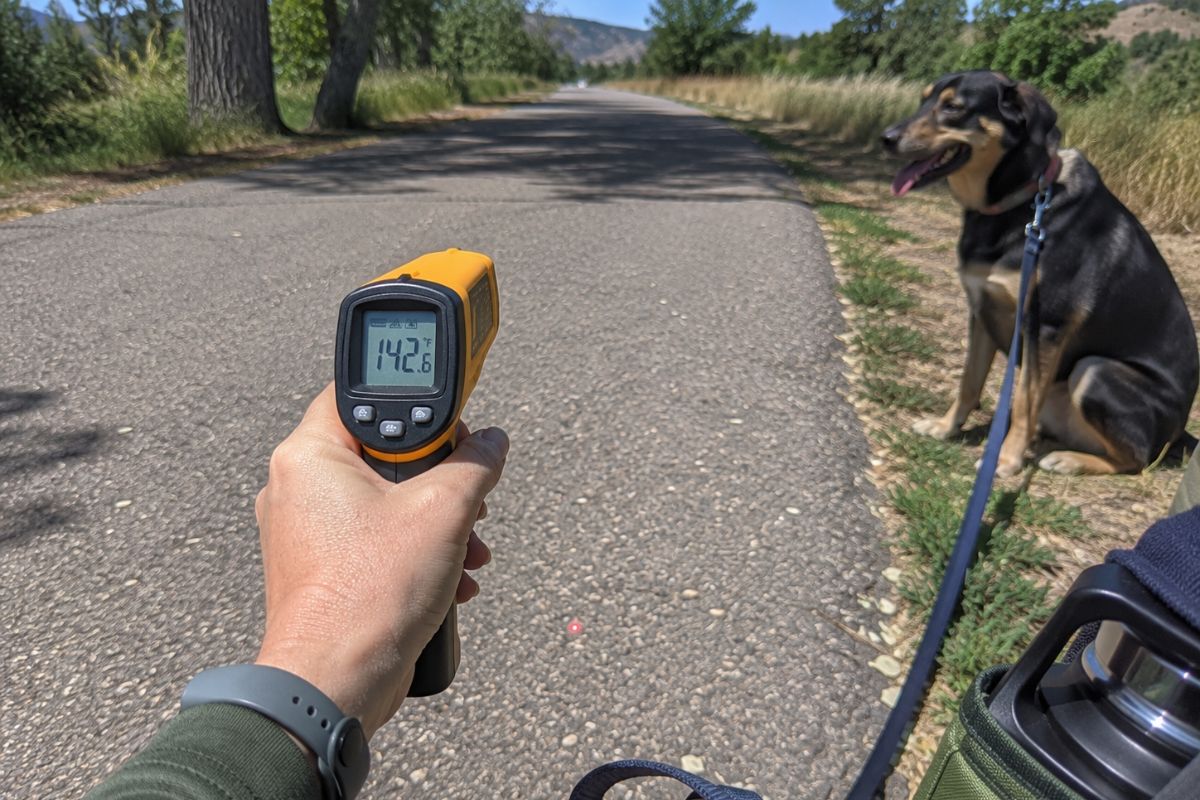
What’s worth knowing: the 7-second test has no peer-reviewed evidence base. It’s a welfare-organization heuristic, not a clinical test. A digital infrared thermometer ($15 to $25 on any hardware site) gives you actual surface temperatures, which removes the guesswork on borderline days.
When pavement burns happen
Harrington et al. (1995, Annals of Emergency Medicine) documented second-degree paw burns within 35 seconds at peak Phoenix summer conditions. At a more typical Boulder figure of 125°F surface temperature, tissue damage begins within about 60 seconds.
Three takeaways: burn risk tracks surface temperature, not air temperature. Asphalt stores heat to a depth of roughly six inches and releases it slowly into the evening. Pavement that’s safe at 9 AM can be dangerous at noon and still warm at 8 PM, even after the air has cooled.
Which Dogs Are Most at Risk on Colorado’s Hottest Days
Brachycephalic breeds: the highest-risk group
Flat-faced dogs sit at the top of every heatstroke risk chart, and the magnitude is striking. Using Labrador Retrievers as the baseline, Hall et al. 2020 in Scientific Reports calculated the following odds ratios for heat-related illness: Chow Chow ×17, English Bulldog ×14, French Bulldog ×6, Pug ×3, Cavalier King Charles Spaniel ×3. Boston Terriers and Boxers also run elevated.
The anatomy explains the numbers. Brachycephalic tracheas can be roughly one-third the diameter of a similar-weight mesocephalic dog’s. That narrow airway means panting, your dog’s main cooling mechanism, is mechanically less effective. On a hot Boulder afternoon, these breeds can overheat during what looks like an ordinary walk.
Are huskies and other double-coated breeds at higher risk in summer?
Boulder County is full of double-coated breeds: Golden Retrievers, Bernese Mountain Dogs, Great Pyrenees, Newfoundlands, Huskies, Australian Shepherds. They look built for the outdoors, and most of the year they are. Summer is the exception.
Hall 2020 found Golden Retrievers carry roughly three times the heatstroke odds of Labradors, a number that surprises most owners. Thick undercoat traps warm air against the skin and slows radiative cooling.
One important rule that runs counter to instinct: do not shave a double-coated dog for summer. The undercoat actually insulates against heat as well as cold, and shaving removes that buffer while exposing skin to Colorado’s high-UV sun.
Other risk multipliers
A few more factors raise the floor at which heatstroke can occur. Body weight over 50 kg multiplies risk by 3.42. Dogs aged 12 or older have 3.15× the odds of environmental heatstroke. Dogs under 2 carry the highest exertional risk, since younger dogs simply push themselves harder.
Underlying conditions matter too. Heart disease, laryngeal paralysis, and hypothyroidism all impair thermoregulation. Common heart medications like diuretics (furosemide) and beta-blockers (propranolol, atenolol) do the same. If your dog is on either, ask your vet for hot-weather guidance specific to their prescription.
The Colorado Walk Decision Matrix
Air-temperature thresholds (adjusted for altitude)
Once you know your dog’s risk profile and today’s conditions, the question of when is it too hot to walk your dog in Colorado becomes answerable. The table below synthesizes the research from earlier sections. Pick the column that matches your dog, find today’s air temperature, and read across.
On UV-high days (UVI ≥8, which is most clear summer afternoons here) or fully exposed routes, subtract about 5°F from each band. Treat it as one tier hotter.
| Air temp | Healthy dog | Brachycephalic, senior, or thick-coated | High-risk combinations |
|---|---|---|---|
| <70°F | Safe normal walk | Safe | Short walks |
| 70 to 80°F | Safe | Short walks, shade, water | Restrict to potty break |
| 80 to 85°F | Early or late only, shade | Potty break only | Keep indoors |
| 85 to 90°F | Potty break only | Keep indoors | Keep indoors |
| >90°F | Keep indoors | Keep indoors | Keep indoors |
Thresholds synthesized from Tufts TACC weather safety scales, EPA UV Index guidance, and Hall et al. 2020. Colorado adjustment based on EPA and USDA UV-altitude data.
Front Range trail picks: shaded options that handle the heat
Not every Boulder-area trail handles heat equally. These are the field-tested options when the matrix lets you walk:
- Boulder Creek Path: partial cottonwood shade with creek access for wading. The best urban hot-day option.
- Chautauqua lower trails: heavy tree canopy and dirt surface. Excellent shaded choice.
- South Boulder Creek Trail: paved but well-shaded, with creek access along the way.
- Heil Valley Ranch: forested dirt singletrack. Beware the elevation and UV on exposed climbs.
Avoid in heat: Marshall Mesa, Davidson Mesa, and exposed sections of the Longmont to Boulder Regional Trail.
Pavement and trail surfaces shift dramatically across a single day. The safe trail at 7 AM may not be the safe trail at 4 PM, which is why heat-aware route selection matters more than picking a single “summer trail” and sticking to it.
What to do when it’s too hot to walk your dog
When the matrix says indoors, your dog still needs engagement. Good substitutes for a walk:
- Indoor scent games and snuffle mats
- Frozen treat puzzles (Kongs, lick mats)
- Pre-dawn hikes before 7 AM, while surfaces are still cool
- Late-evening walks after 8 PM, once pavement has released its stored heat
Off Road Paws’ pet sitting visits include indoor enrichment specifically designed for heat days, so your dog stays mentally tired even when the thermometer says stay home.
What to Do If Your Dog Overheats: Cool First, Transport Second
Even with good planning, heat emergencies happen fast.
What are the early signs of heatstroke in dogs?
Catch heat stress at the earliest stage and you can usually resolve it in the next ten minutes. Wait for the later signs and you’re managing an emergency. Watch for:
- Excessive panting and a noticeably slowing pace
- Seeking shade unprompted, or refusing to keep moving
- Thick, ropy saliva
- Bright red or unusually dark gums
- Unsteady gait or visible weakness
If you see any of these, stop walking immediately, move to shade, and offer water.
The 2023 to 2024 cooling-method update
For years, the standard advice was “never use cold water, use cool water, to avoid shocking the system.” That guidance has been overturned. Hall et al. 2023 in Veterinary Sciences found that only 21.7% of UK heatstroke dogs were cooled before transport to a vet, and a 2023 Penn Vet randomized trial showed partial cold-water immersion outperformed slower alternatives.
Current consensus: cool first, transport second. Start cooling before you start driving.
The protocol:
- Pour cold water on the belly, paws, and neck. Full immersion in a tub, kiddie pool, or creek if you can manage it.
- Wet the dog thoroughly and use airflow. A fan at home, or the AC vents on full in your car.
- Call the emergency vet while cooling is underway, not after.
- Stop active cooling once your dog reaches about 103°F. Going lower at home risks an overshoot into hypothermia.
Boulder County emergency vets (confirm hours before going)
Save these numbers in your phone before you need them:
- Alpenglow Veterinary Specialty + Emergency, 3640 Walnut St, Boulder. 24-hour. (303) 443-4569
- Colorado Animal Specialty & Emergency (CASE), 2972 Iris Ave, Boulder. 24-hour. (303) 545-2273
- Veterinary Emergency Group (VEG) Boulder, 1905 29th St, Suite 1176, Boulder. 24-hour. (720) 738-9994
- BluePearl Pet Hospital, 2000 W South Boulder Rd, Lafayette. 24-hour. (720) 699-7766
- Aspen Meadow Veterinary Specialists, 104 S Main St, Longmont. 24-hour. (303) 678-8844
- CSU Veterinary Teaching Hospital, 300 W Drake Rd, Fort Collins. 24-hour. (970) 297-5000
Always call ahead so the team can prep for a hyperthermia case before you arrive.
Three Habits That Make Colorado Summer Walking Safer
Generic dog-walking advice treats every 85°F day the same. The research, and the physics of living a mile above sea level, say otherwise. Colorado’s altitude raises UV intensity, accelerates pavement heating, dries the air faster, and shifts the math on what counts as a safe walk. The same temperature your friend in Atlanta walks her Labrador through can put your Golden in real danger here.
If you take away just three habits from this guide, make them these:
- Walk before 8 AM or after 8 PM during Boulder’s hot months. The surfaces and the UV are both meaningfully friendlier.
- Do the pavement test every single time before you step off the curb, or carry a $20 IR thermometer.
- Know your dog’s specific risk profile (breed, age, coat, health, medications) and let it set your thresholds, not the forecast.
This is exactly the framework the Off Road Paws team uses every day: veterinary-informed care, heat-aware route selection, shaded-trail prioritization, and indoor enrichment alternatives for RED days. If you’d like a hot-weather walking plan built specifically around your dog’s age, breed, and health, get started with a free consultation to map it out together.
Your dog deserves the version of summer that’s actually safe for them.
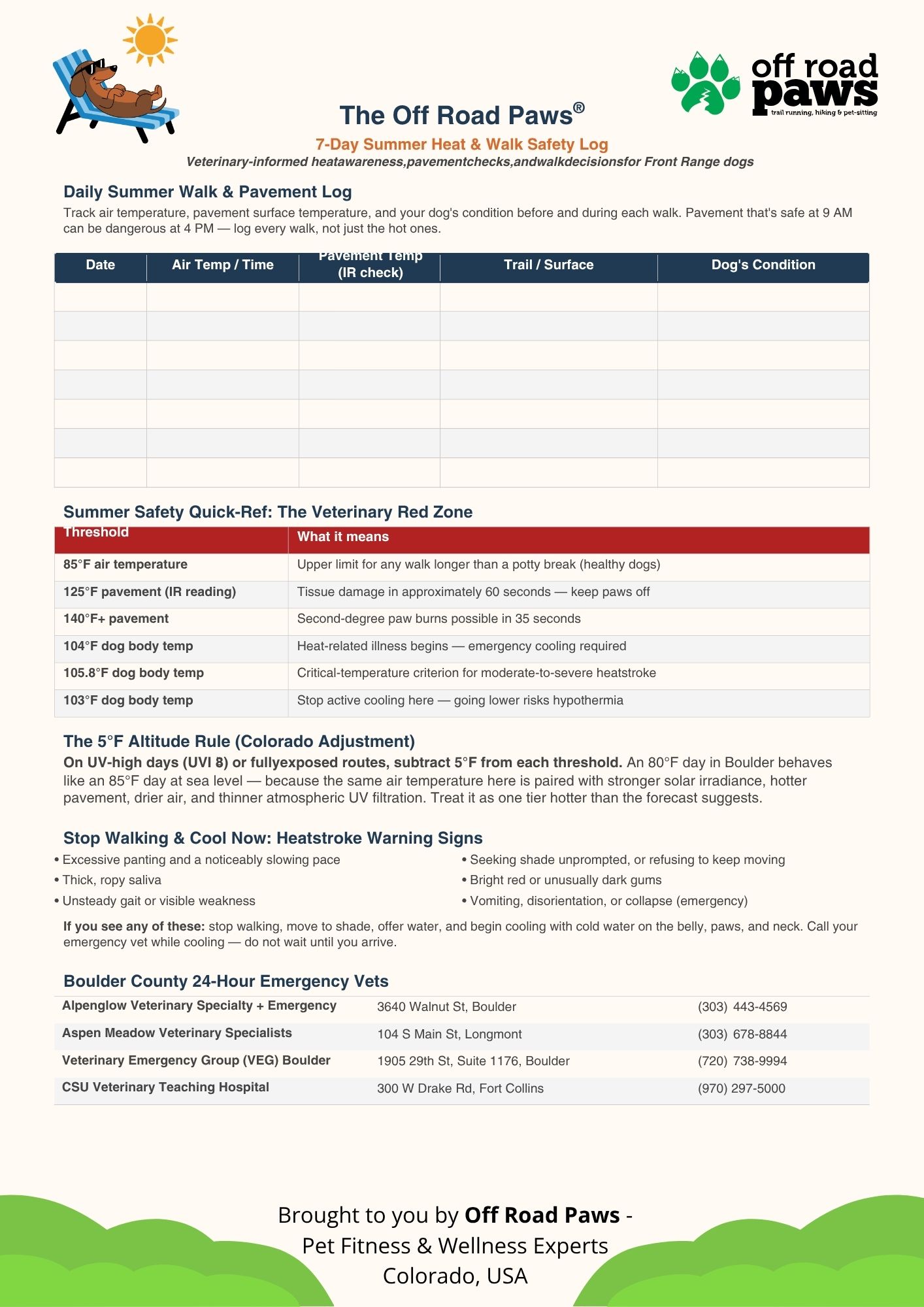
The 7-Day Summer Heat & Walk Safety Log (Printable PDF)
Don’t want to memorize every threshold and emergency vet number? We’ve condensed the core safety logic of this guide into a clean, fridge-friendly PDF. Save it to your phone, print it for the leash drawer, and use it the next time the forecast climbs.
- Daily Walk & Pavement Log: Track air temp, surface temp, and your dog’s condition for seven days.
- Veterinary Red Zone Quick-Ref: The six thresholds that matter, from 85°F air to 103°F body temp.
- Colorado Adjustment & Emergency Vets: The 5°F altitude rule plus six Boulder County 24-hour clinic numbers.
Sources Snapshot
This guide draws on peer-reviewed veterinary research, government climate and UV data, and major veterinary-organization guidance. Key sources:
- Hall et al. 2020 (Scientific Reports) / (Animals): the foundational 905,543-dog primary-care study; exertional vs environmental vs vehicular heatstroke breakdown; breed odds ratios.
- Chestovich et al. 2023 (Journal of Burn Care & Research): modern peer-reviewed surface-temperature measurements (75,000 data points across six materials).
- Berens 1970 (JAMA) / Harrington et al. 1995 (Annals of Emergency Medicine) / WSU veterinary outreach (2017): original asphalt-temperature chain and paw-burn timelines.
- NOAA Physical Sciences Laboratory, Boulder: Front Range climate baseline (32.7 days/year ≥90°F normal; 43.6-day recent five-year average).
- U.S. EPA and Lantz et al. 2006 (USDA UV-monitoring network): altitude-UV relationship.
- Parnes et al. 2023 (Animals) and Hall et al. 2023 (Veterinary Sciences): updated cooling protocols and the “cool first, transport second” evidence base.
- 2026 VetCompass clinical grading tool (Hall et al.): current heatstroke severity thresholds.
- AAHA, AVMA, Cornell, Texas A&M veterinary guidance: definitional and best-practice baselines.
- Tufts TACC scales: foundational dog heat-index framework.
About the author: This article was written and reviewed by Dr. Kira, DVM, founder of Off Road Paws. Dr. Kira brings 12+ years of small-animal veterinary experience and membership in the American Veterinary Medical Association (AVMA) and Pet Sitters International to every walk, hike, and run her team leads across Boulder County.